One of the characteristics of patchwork is to spend time together, to sew together while talking of our lives or just chatting to have fun, to learn something new, to meet with other quilters having great moments.

These were our habits, things that have been thrown away in a few days. Suddenly, international sanitary emergency has interrupted physical connections and has inhibited travels. Now we can’t move even if we would like to do it! After a first moment when everything has stopped (national fairs and international festivals cancelled in Europe, in USA and in the rest of the world, up to part of the next year), something starts to move. After a few moments of loss, someone begins to do the only possible thing: trying to react.

It is since decades that technology is playing an essential role in our lives and helps the diffusion of modern patchwork: we can stay in touch with our old friends and have the chance to meet new people from the other side of the world.

Since a couple of months, international patchwork community (with prompt actions in USA and UK) launched live digital meetings and workshops, that gave the chance to more people to access to content previously reserved to single and local groups. Quilters in remote countries, now getting new accessible opportunities, are thriving!
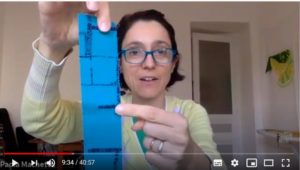
We have a lot of announcements of on-line workshop, exhibitions, international festivals etc. Many artists organize on-line courses, we will see on line challenge’s galleries and we will participate to inauguration ceremonies staying at home. I think this is a great and quick reaction!

What will happen once this emergency will finally end? For sure it is better to travel, to be free to see and to meet people, but I hope that something will remain, keeping both approaches. A real life on one side, and the chance to have access to events organized from everywhere in the world on the other side. That’s a game changer. I’m a teacher and I believe that learning is always something to be pursued.

We noted that live courses go quickly sold-out. Thus, we started to follow multiple channels to discover events and open opportunities, just in time to enroll. Sources of information range from authors web sites and newsletters; guild calendars (some guilds started opening live courses to non-guild members); pictures on the socials showing work in progress by course attendees (such course may have future sessions available: Paola asked to be inserted in a waiting-list after following the experience of an on-line contact); e-learning platform news; quilt-shop initiatives; and obviously international patchwork events going live with virtual workshops and challenges.
Here below we list some on line events or artist classes dedicated to improv, to which Carla, Paola and myself have enrolled.

https://www.quiltcon.com/ (workshops almost fully booked)

https://www.thefestivalofquilts.co.uk/ (on-line gallery contest and workshops)

https://sherrilynnwood.com/livestream-quilting

http://www.joecunninghamquilts.com/online-classes

https://www.cindygrisdela.com/page1-2/

https://carolelylesshaw.com/

https://www.ireneroderick.com/workshops

http://suebleiweiss.com/globalquiltconnection.html

p.s. if you want, you can also participate to our Instagram game:

https://quiltimprov.art/orange-summer-challenge/
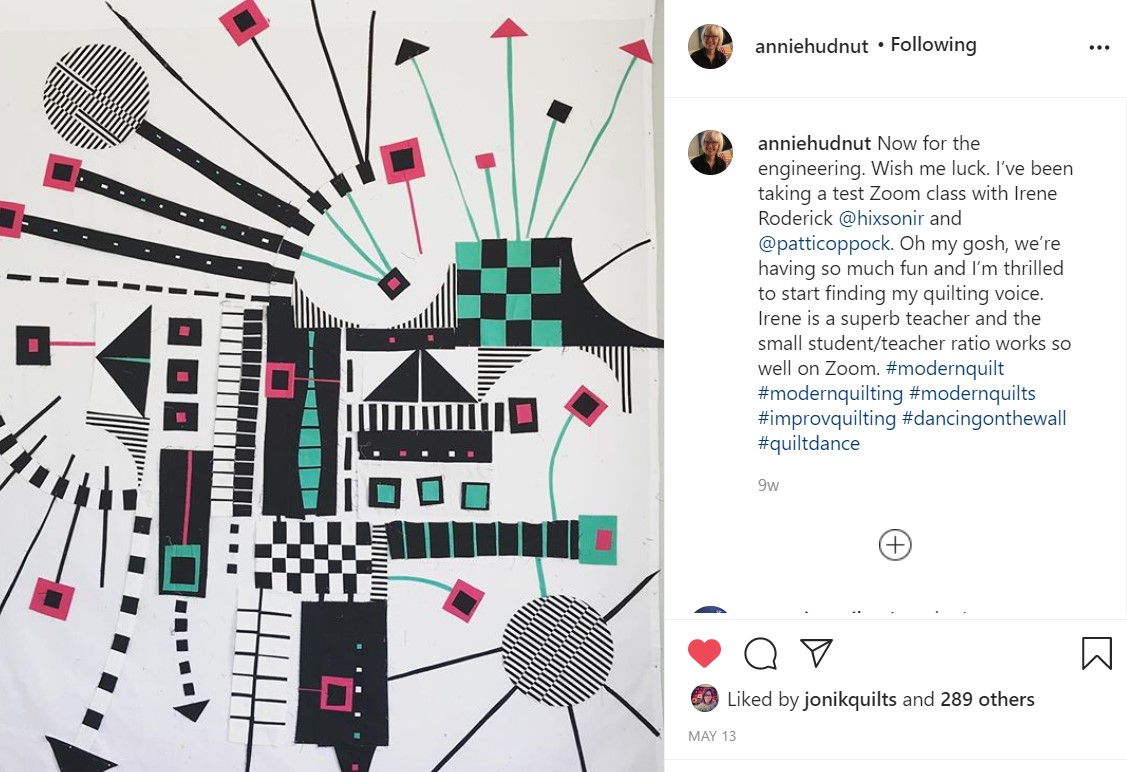
image courtesy of @anniehudnut, all rights reserved
 

The route indicated by improv process, sometimes takes unexpected turns. This is one of such stories.

A few months ago, while I was testing a challenge of our own with Giovanna, we selected 13 fabric colors to be used by both of us, so that each of us would compose a quilt dedicated to color green.

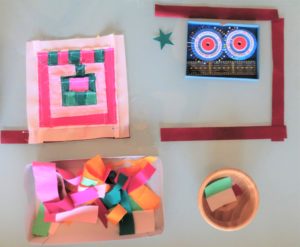
Giovanna was checking whether our color combination was working well, by trying the palette with a software that creates nested squares. Maybe seeing the image of her trial has influenced me: I started sewing my work, by coupling colors in a composition based on squares.

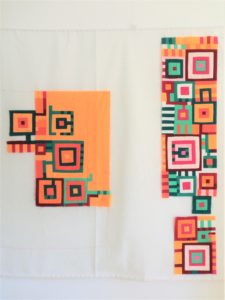
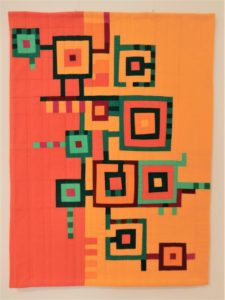
Day after day, switching and adjusting block position, I prepared enough pieces to fill the chosen size on the design wall. The figures were growing from left to right, from a crowded corner towards a bit of negative space, as if the blocks were going with the wind. At that point, everything seemed ready, it was only required to unite the blocks. But… I felt uneasy… something in the composition didn’t fit.

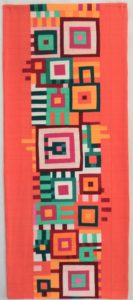
Suddenly, the mother quilt divided itself into two children quilts.
It was like the duplication mechanism of a cell that splits into two cells: biology calls it “mitosis”…

So, the route of improvisation led to two different paths, and I finalized two distinct quilts. Which, by the way, played me another trick: they forgot the quest for green, and decided to be dressed in orange (a-ha, orange likes to become a dominant color! Our first public challenge knows it well…).

At the end of the story, I started a third quilt to respect the initial goal set between Giovanna and myself, and for the third one I really used a lot of green. But this is another story…


I believe that the choice of the fabric required to start a new quilt is an important phase for every quilter, because it will influence the coming project. And this is even more relevant when starting an improv quilt.

For me, a long search is needed: I dig among my fabric collection, I pair some of them, I choose and I discard other ones… I group all the valid options, selected as analogous or contrasting color respect to the starting main one.
As soon as, in the gathered fabric, it emerges a suggestion for a quilt initiation, I stop the search.
I literally stop: I don’t go to the sewing machine, but I rather pile the collected fabric, and I let it rest and decant, as if it were a wine waiting to become ready for being tasted. I peek at my pile every time I pass near the fabric, I let some days pass… and when I feel confident that this choice is my choice, only then I go to the cutting mat.

I’ve been quilting for 25 years, and I’ve collected fabric everywhere, including New Zealand!
It’s always been fun to visit fabric shops and sites dedicated to quilting… each time I had the possibility to travel, my luggage carried back home at least a small piece of fabric, to be added to my stash, with the idea that one day it will find its place inside a quilt.

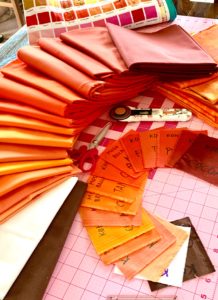
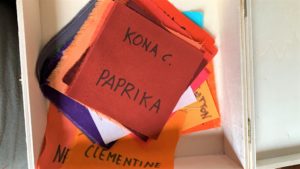
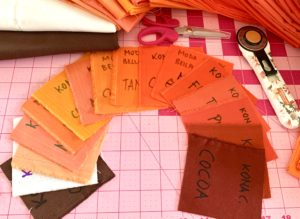
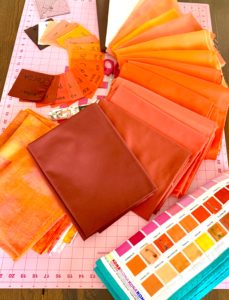
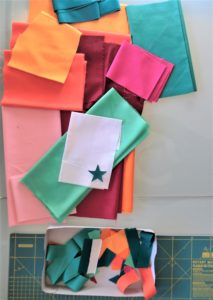
Orange has a special place in my heart: thus, now, it’s been a joy to search all its shades accumulated in many years! It’s not been easy to catch them all, but, after a long search, I had a large amount of fabric in front of me: a feast for the eyes, and an opening of memories: “what about this piece?”.
I recalled moments from twenty years before, when I folded a new purchase and put it aside because it seemed too precious to be cut immediately; I remembered where, why, with whom all of this had happened… I touched the tissue, and a sudden memory of past beauty was revived. 

To identify one by one the solids I’ve found, I started to study and to dig for information, with color maps and online databases. I noticed that most of my solids came from two main suppliers; sometimes it was difficult to distinguish between them, and I was surprised to discover that in some occasions the same name was applied to different shades! For this reason, in my palette you will find: two nectarines, two mangoes, two clementines… names that make we think of juicy fruits, of sunny tints… quite appropriately, since we are talking of orange colors!


Now I’m ready: the palette is defined, with 16 solids, 3 grunge and some other prints. Too many? Maybe: I don’t know if I shall use them all. Let’s see how the work will go on. A slow start can be allowed… waiting for the right idea to take shape: we are talking of improv, aren’t we?