Improv Black and White game started a few weeks ago, and some early-bird finished quilts arrived.

“Birkenwald in winter” by @patchbri
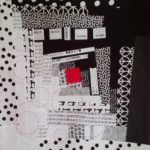
“Improv black and white ” by @silviafic8
We aim not only to showcase the precious quilts completed by participants on @quiltimprovstudio gallery, but also to learn together by sharing comments on the experience done. Moreover, we start to see the habit by some of the participants, of returning to our games, after having tried earlier ones: we’re honored by that! This is an opportunity to know something more about quilters who love doing patchwork in improv mode! Thus, in this article, you will find some background stories from our participants, and the feelings expressed both by newcomers and returning quilters.
First of all, we asked quilters who completed their work, what were their preferred features of sewing in black and white. Graphic effect, focus on shapes, rhythm, other? See their replies below.
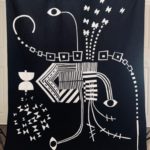
“Ms. Anglerfish” by @quiltergardener
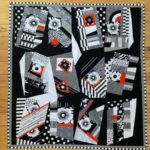
“Retro 66” by @arttextiles
@quiltergardener said: “My favorite part about working with black and white was the simplicity of removing the need for choosing colors and focusing solely on shape/form and movement. The limited palette was liberating! Also, a B&W quilt looks stunning in any room decor.”
@arttextiles wrote: “In my case, the use of black and white allowed me to really study the graphic effect without being clouded or distracted by other colors and only using one other color to really enhance the balance between the black and white fabrics. Using a mid-century approach of 1960’s simplicity, I found this easy, as I was conscious of using as near as possible a 50/50 balance between the black and the white, as in the Op-Art trend of 60’s popular art.”
@patchbri found black and white scraps from earlier works of her, dated years before! These scraps became the start for her work, and she made up to two quilts for our game! Not too strange, since she really loves black and white: she feels it is a perfect combo.
Is it difficult to work with black and white, considered that everything you do pops out so strong? @silviafic8 wrote to us that she found it very easy: there is no need to think about the preferred color to be matched to the earlier block done: each piece works well with the earlier piece! After that, she enjoyed the great contrast effect.
Also @morphea80 felt at ease with such colors. She said: “When I heard about your new challenge, I wanted to take part straight away. About three years ago I sewed some mini quilts exclusively in black and white and an accent color that brought me closer to the special feature of this strong contrast between light and dark. So I was able to follow up on these experiences. My existing fabrics partly dictated the design, as some fabrics were only available in the form of strips.”
@pieladyquilts, on the contrary, was not used to such a small number of colors. She said: “My normal preference is to work with many colors. Sometimes 20 doesn’t even feel like enough! Working with only three colors was a challenge. Instead of relying on color, I focused on creating a strong graphic pattern. I began with only black and white and waited for inspiration on how to add an accent color. Once I noticed a circular secondary pattern emerging, I decided to use my one accent color to highlight it.”
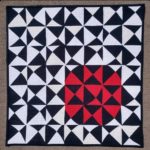
“Better with curves” by @pieladyquilts

“New York” by @auroraa1714
As a second question, we asked participants how they approached composition.
@auroraa1714 explained: “I try to play with the position of the elements, breaking a little the rules of line or size. I love the idea of creating wall quilts as art that can be hung in the direction that you feel, that you like… and after some time you turn it 90° and it is another quilt.”
Aurora put her black shapes on the front of her cityscape, instead of using black as a background, with a purpose: “We often use black and white as a backpart color, or as a not-so-important color. That is why I love to give them more importance, more attention.”
Will this be her last black and white work? It seems not, in fact she adds: “I love working with black and white… I have another quilt in mind!”
Also @gigi.v13 gathered ideas for future works: “I started this challenge with the idea to make wedges in the colors of black, white and cool green, with no other plan. I have not worked with black and white before and it was surprising how much I enjoyed it – without the distraction of multiple colors, the process was so much more about the forms and the composition. I did like the addition of one color but at the end it felt a bit distracting and I will use less of the color next time – less is probably more in this regard. For the same reason, I will try to have more negative space next time. I need to fight my tendency to achieve balance by creating symmetry, which I think decreases movement.”
@arttextiles described her process: “I am very conscious about up cycling and often use garments from Charity/Thrift shops: this allows a unique and individual look, as these fabrics have either been discontinued or are not available by the fabric length. The flower fabric used in my quilt is an example of just such a find, and it was the original inspiration for the design of this quilt using other black and white fabrics to complement it. This is often the way I approach a design.”
@quiltergardener explained her improvisation sequence: “With this quilt I started out by making a few simple shapes: stripes, half circles, and eyes. I put them up on the wall and thought about how they might be connected: thin lines, squares, points of a triangle. It can be scary to not know what your quilt will look like (am I wasting my time making something ugly?), but after years of practice with improv you learn to trust yourself. And if you do make something you don’t like, toss it into the scrap pile! Don’t let it prevent you from trying again. You learn from making something you don’t like equally from something you do like.”
Magdi @bagarusmag considered the effect of her work, when finished and hanging on the wall: “I like the black and white color: it fits in our apartment. The composition was shaped by my mood, the visual impact was also important. For the very contrasting colors, I chose a warm color that also defined the theme.”
She continued telling something more about herself.
“I am Hungarian, I met quilts 7 years ago as a retiree. It has always been important for me to make, to knit, to sew things to my own taste. As a new life situation awaited, I thought of learning something else. That’s how I started sewing. For me, the past year has provided a wealth of experience in the challenges of @quiltimprovstudio. I met you at a lovely earlier prompt, using my favorite color in the orange game. I enjoy the work of various international artists, using improv as a technique that gives a lot of freedom and creativity. Joining such games gives inspiration, support, encouragement. It was a great idea to create this group because the studio holds together improv lovers. The world opened up to me: I found a host community during the covid-19 epidemic.”
While Magdi returned to our games several times, other newcomers joined, such as @arttextiles, who commented: “thank you all so much for the opportunity to participate in your challenge. This is the first challenge I have entered and I enjoyed it immensely!”
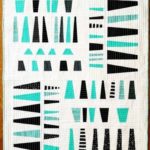
“Frigid” by @gigi.v13

“Here comes the sun” by @bagarusmag
Thanks also from our side, to all participants who completed their quilt until now.
The black and white game continues until May 16th: there is time to join, to start, and to finish new quilts!
You can follow works in progress, and new results published while we were writing this article, at the dedicated Instagram hashtag page: #improvblackandwhite

“Avanzi” by @patchbri
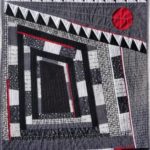
“Housebound” by @morphea80
 English
  Italian