The material we use when we start sewing improv, can have a consequence on the resulting work.

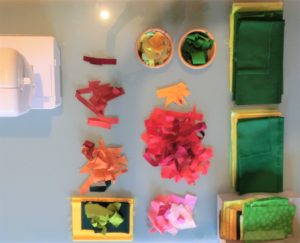
For example, I’ve noticed that the size of the fabric I group on my sewing table as a fresh start, occasionally influences the piecing mesh I will finally execute.
Do I have available large yard stash?
Do I prefer to handle medium pre-cut strips?
Do I recover all tiny-piece leftovers having the same colour of the planned palette?
For me, the initial input sometimes happens to remain embedded in the coming composition, such as: in the tessellation scale, in the shapes elongation… even if at the beginning there was no intention for it.
May small gestures subtly create recurrence?

Recurrence easily translates into repetitions.
Repeated gestures are a very natural element for improv quilting.
The act of piecing and sewing has its own rhythm that is reflected in the resulting image; the more repetition is effortless, the better uniformity is achieved, so that the flow of composition stays mirrored in the fabric without hiccups.
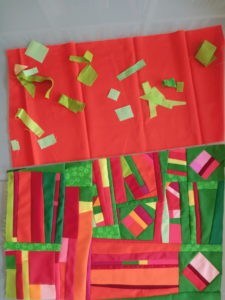
Sometimes I ask myself if I can keep repetitions regular for a long time.

If unity of time, space and subject is adopted during piecing (as in Aristotle’s drama rules!), my resulting texture remains uniform. If, on the contrary, my top piecing is interrupted by other projects, and re-started after some mind changes, then fabric may play unexpected tricks. Some extra-feature slips in, changing the mark-making act…
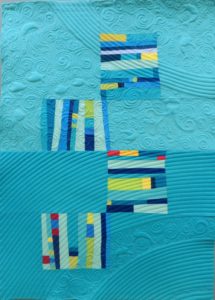
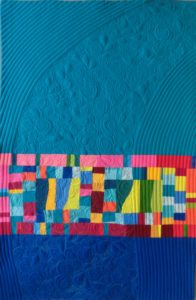
For example, it took me one year to complete “Dam”. When I started, I allowed sewing line to follow scrap border irregularity. Months later, I introduced a straightening cut to each block. Only later I understood that, from that moment on, all the composition took a turn.

How will I deal with #blueimprovrepetition challenge? I still need to start, but I can already look at the examples from quilters who joined us, and have shown their progress. I can peek on sewing gestures taking place in sites upper than Northern Polar Circle, in Australia, in Chile, in Russia, USA and so on…
I can’t wait to be with them!
Before the launch of the new Quilt Improv Studio game, we proposed a poll to quilters interested to participate, in order to decide whether one or more shapes will be used during blue improv repetition challenge. The result was:

ONE!

Thus, each participant shall decide which shape to use within the quilt.

SHAPE

Since that day, I’m thinking about the meaning of “shape”.

The first understanding of shapes goes back to childhood memories. Primary shapes are squares, rectangles, triangles, circles; many baby toys are made with such shapes, aimed to be inserted within holes, or as fancy buttons that sing varied tunes, or combined with meaningful colors. Our experience returns to these cubic blocks when we, as adults, play with babies on the floor, allowing that cylinders, balls and stars gather on the carpet and roll happily around.

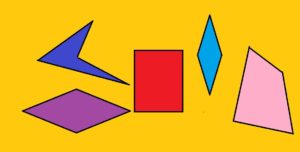
When learning geometry rules at school, we understand that the shapes may be of many more types. Shapes are classified by the number of sides, and their names acquire complexity… who remembers what’s an icosahedron or a dodecahedron? Maybe the gems of the Seven Dwarfs can give an idea? And the irregular rhombus of a kite? And the symbols, the letters and so on? #@&%$! We live in an universe of shapes!

After those scattered experiences, we arrive to the question of today: which shape to use for our quilt?

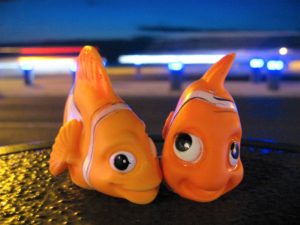
I’m still thinking of that: I’m searching for the magic shape, that allows me to express the idea floating in my mind. Blue palette is ready, and the fabric I’ve collected is suggesting me a theme. Maybe I will change my mind during the improvisation process, but in this starting phase, I visualize a deep ocean, soft waves, swimming fish… a tropical and calm sea, fat and slim marine creatures, splashing around, like in a day dream… 

Which form can render this?

Can I call a fish “a shape”? How many sides, straight and curved, are required then… if I can manage to sew it at all?

My background as a Math teacher brings me back to practicality: piecing and engineering needs prevail. I’ve decided: I’ll use four sided shapes. One rule, many possibilities for repetition and deformation… perfect for improv!

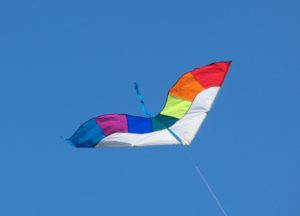
My list is done: good fabric, simple rules, evocative vision… am I ready to start? How easy is to translate fantasy into something real? The improvisation path is open… A populated ocean is free to evolve, and possibly turn into a sky filled with flying kites!

Let’s join the participants of the  #blueimprovrepetition  game, and you will see how the story goes on.

Some time ago, my mother visited my home, strolled around the corridor, checked all the rooms, looked at my wall panels, and concluded: “You make too many blue quilts!”.

One of my early quilts was made using almost only blue. I pieced some striped blocks, I tried their position on the table, right near the solid fabric remainder. It looked so nice that I decided to embed that solid as negative space. I allowed myself to piece blue lines on light blue background, in spite of their similarity. The resulting quilt had very mild contrast: pieces seemed not separated objects, but rather ripples within the same object. That Kona shade was named “pool”. Quilt title became “Water”, and free motion quilting populated the waves with diving creatures.

Blue color is often in my gaze.
I live in a town facing the sea.
I love exploring river courses with my bike.
I noted that there are recurrent water related subjects in my quilt titles: “Lagoon”, “Seaside”, “Fountain”, “Nautilus”, “Pond”, “Boat race”, “Ford”, “Dam”.
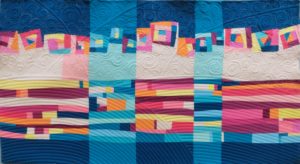
I’m not the only one who feels immersed inside blue subjects. Also my son, when observing this quilt of mine full of deep blue, decided to name it “Sails”. It’s incredible how a slight curvature is capable of transforming a triangle piece into a moving vessel. 

So, combination of a certain shape and a certain colour is enough to become evocative? I shall be aware of this, before I pick the shape to be used in our next improv game! In a past quilt of mine, where I cut wavy pieces while using just a spark of blue, this combo was enough for me to choose its title as “Tide”.

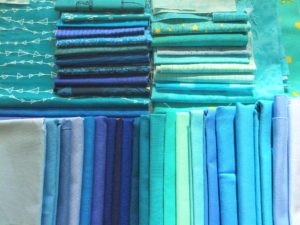
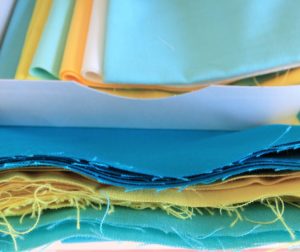
Today I collected all the blue fabric in my stash, and I found some double pieces. When I visit my favorite quilt shop, I often end up buying their blue solids again and again. I can be sure it will be used someday.

I must admit that, before taking this picture of my fabric, I cleared off the doubles. Among this pack, I will select my favorite shades. We are all busy with preparations: Carla has retrieved her blue fat quarters coming from New Zealand; Giovanna is checking that, among us, we choose different shapes; I’m adding contrasting colors to the blue field that fills my sewing desk. And you? How do you select your starting material for the  #blueimprovrepetition game?