Did you imagine that, while playing with black and white for our improv game, we would talk about color?
We asked our participants, who published their finished quilts during the second month of the challenge period, how they selected their accent color to be placed aside the black and white fabric. Quite interesting background stories emerged. So different experiences are tied to a little bit of accent! Read here below.

“Searching for Spring ” by @piecefulwendy
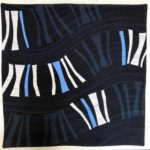
“Some are Invisible” by @kathycookquilts
@hollygrovethreads explained why her work is titled “Stella’s Green”.
“Stella was my grandmother’s name and the shade of green I used reminds me of the color in her kitchen. I spent much time with her as a child and she was one of the women in my family who sparked my interest in sewing and quilting.”
@blabshandgemacht had some constraints: “First I planned to take bright orange as the accent colour; but, due to lockdown I had to take what I had. And now I am very happy with the light green! It seems much less aggressive but still strong enough to stay in balance with black and white.”
When only one color has to be selected, there is time to pay attention to its choice. @piecefulwendy did so: “First I auditioned different colors with my black and white fabrics, to see what color appealed to me. I really wanted to do something different, but the lime green just couldn’t be ignored. I had planned to just add slivers of green, or possibly just one pop of it, but once I started the curved pieces, the green earned more of a place in the quilt.”
@kathycookquilts thought of the overall match: “I auditioned many colors to go with the black and white for this challenge. Blues are a favorite of mine so I concentrated on them. The blue I chose had a mid value that worked well with the two extremes of black and white.”
@mariurbezg tried colour presence at a minimum. She wrote: “The small accent of colour was a very good idea. Even if, in my work, it is just a few pieces of fabric with a bit of colour on it. It is enough to give to the quilt more life and light.”
For @margaret_stamford the choice of accent color was an occasion to experiment. She wrote: “Had I not given my color choice much thought, I would have chosen a saturated bright. Instead I challenged myself to choose a subtle color that one might think wouldn’t pair well with edgy black and white. Mostly I used a pale pastel, Sea Glass by Kona, which I think works because of the high-contrast. Glad I took the risk!”
With clear black and white shapes popping out, the quilting phase may need to follow accordingly. @margaret_stamford proceeded in this way: “The quilting on this piece was totally improv, with the intention of emphasizing the design. I could foresee that all straight lines would stop the movement in the center part of the quilt so I opted for some central curves that would run off of the edges to add movement. The rest is linear and complements the title, _Constraints_.”
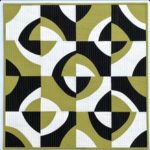
“Stella’s Green” by @hollygrovethreads
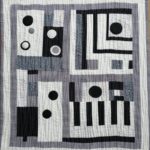
“Explorando” by @mariurbezg
Secondly, we asked if there was any source of inspiration concerning improv quilting, that our participants wanted to share.
@kathycookquilts replied: “For me, inspiration is usually the result of play. I’ve been experimenting with cutting shapes up and inserting negative space while trying to maintain some semblance of the original form. After trying and rejecting a barrel shape, I used the scraps from it to make the quilt for this challenge! I get good ideas from scraps! A lot of my experiments don’t result in a finished product, but I really enjoy the journey!”
The source for the geometries chosen by @blabshandgemacht was in her surroundings. She told: “The inspiration for my black and white plus one color quilt came from the old wooden floor in the apartment I grew up.”
@hollygrovethreads focussed on shapes: “I have been enjoying experimenting with improv curves piecing and chose to use it for this wall hanging. I find curved piecing to be easy. I think that may come from my previous experience with garment sewing, as it is much like sewing in a sleeve on a garment.
Even in my improv work I enjoy incorporating some structure and pattern in the layout. In this work, although the curves are improvisational, there is an underlying structure and pattern that ties each block together.”
@mariurbezg looks around for quilting ideas: “It’s always nice to see other works for inspiration. Now I’m trying to incorporate into my quilts more free-motion quilting… This kind of quilting pairs very well with improv piecing, in my opinion.”
For @piecefulwendy there are several artists who have had an impact on her shift to improv. She lists: “Debbie Jeske (@aquilterstable) has inspired me with her creative flow, and I would credit her kindness with giving me the push to explore and play a bit more. Nicholas Ball‘s book Inspiring Improv has also been helpful and given me some new techniques. I’ll be taking some classes from Carole Lyles Shaw this month, and I’m excited about that.”
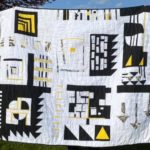
“Steps” by @karinaquilts

“Constraints” by @margaret_stamford
We are happy that our games continue to be an opportunity for newcomers to improv: this time, it was the turn of @karinaquilts .
She wrote: “This was my first improv piece and I used this as a way to start and learn about improv quilting.
I jumped in very quickly to this challenge and gave very little thought to how my quilt would progress. I just started sewing with the only three black and white fabrics that I had in my stash and went with the flow. I made some shapes and continued from there. My first few pieces were stark black and white solids together. I liked the effect of the big graphic black and white solid shapes and stripes together. So I continued on that theme. I liked how the bright yellow popped against the black and white.
Overall, this has been a huge learning curve for me. It was very challenging at times! I jumped in, learnt a lot and will be a lot wiser for my next improv challenge.”
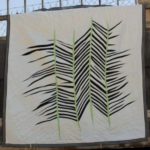
“Namenlos” by @blabshandgemacht

“Stream” by @thecultofquilt
There is still one week to go, until our game deadline: for the black and white works completed within May 16th, we make available the possibility of being published on @quiltimprovstudio gallery. We invite you to follow it, and to appreciate the new quilts that continue to arrive these days!
 English
  Italian